
Such a mess
Pasticium, the ancestor of French pâté and Italian pasticcio. And my vegetarian terrine

Hi, I’m Monica, a food writer and cook with a background in historical research. First of all, thank you for being here!
Please take a moment to click the heart at the top of this post. It helps this newsletter gain visibility. It’s a small gesture for you, but it means a lot to me. To receive new posts and support my work, please consider becoming a free or paid subscriber. Grazie!
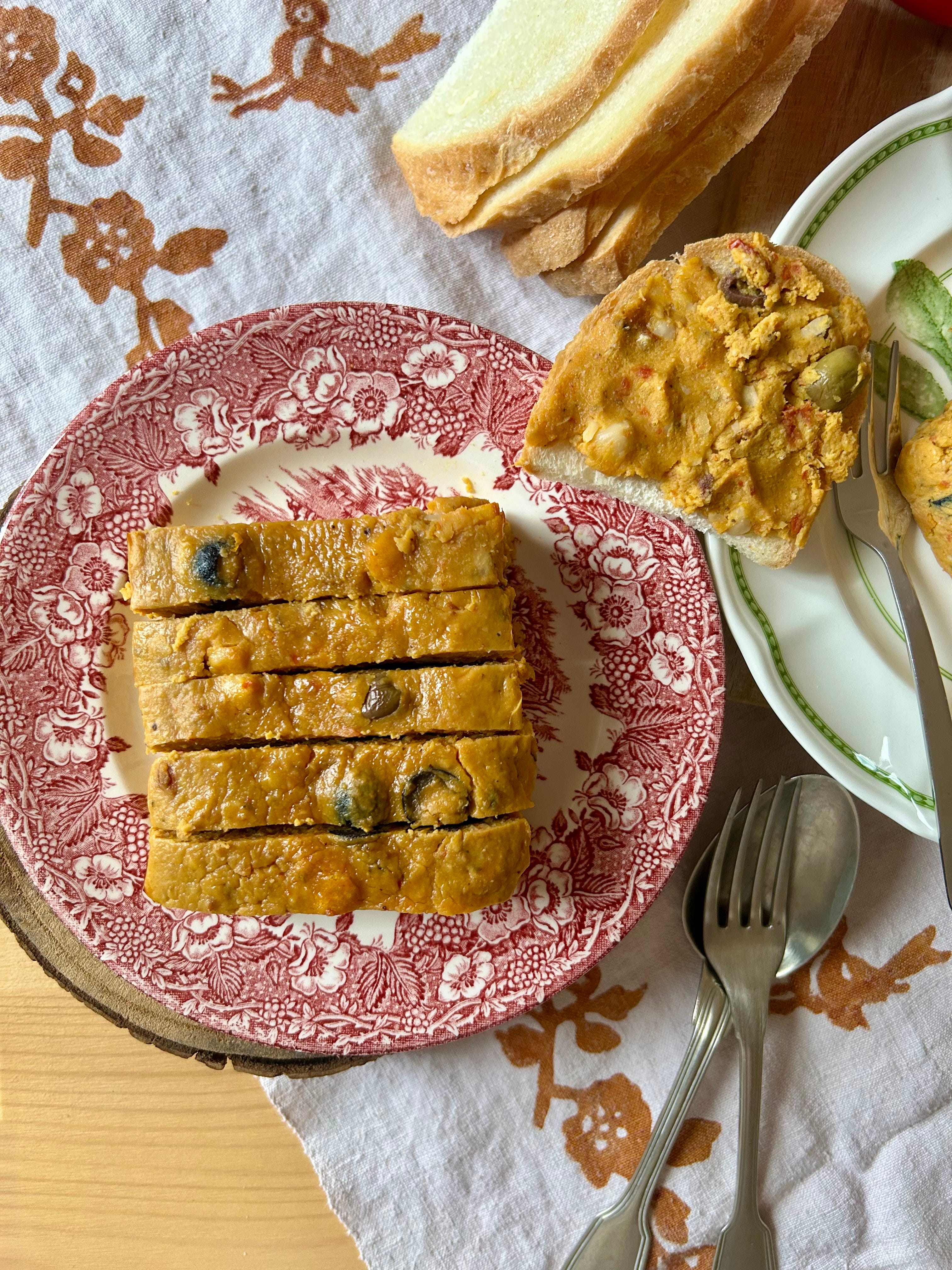
I didn’t grow up eating terrines and pâtés, but I have fond memories of the pasticci (savory pies) I ate and made as a child, since pasticcio in Italian also means a mess. I could say the same about certain sformati, especially those reminiscent of a rustic terrine, where the fine pulp is dotted with colorful, flavorful spots that break up the slice a bit when cut, but that’s okay.
One thing is sure. I grew up at a table rich in flavors and lessons.
In my childhood kitchen, I learned that nourishment feeds not only the belly but also the mind. Curiosity is a hunger that must be satisfied. My life as a researcher of History first and of stories today began there.
I could have become an excellent detective, but then I won a PhD in History and Information Technology, and here I am.
I would have earned more as a detective than as a food hunter of stories from the kitchen, but, as my husband says, I wouldn’t have eaten so well.
And so, here is the question from the menu of this newsletter.
If the French word pâté means pasticcio in Italian, is there a connection between the two dishes?
Now don’t tell me you’re not a little curious too.
Common origin, different recipes
Despite their common origins, today’s table shows only their differences. No, I won’t say that pâté is Italian. But it’s true that recipes travel, change, and leave traces. Let’s see what they are.
For the vegetarian terrine recipe, scroll to the bottom of the letter. You can decide whether to serve it with a baguette or Italian bread. For everyone else, let’s begin a journey through time and history.
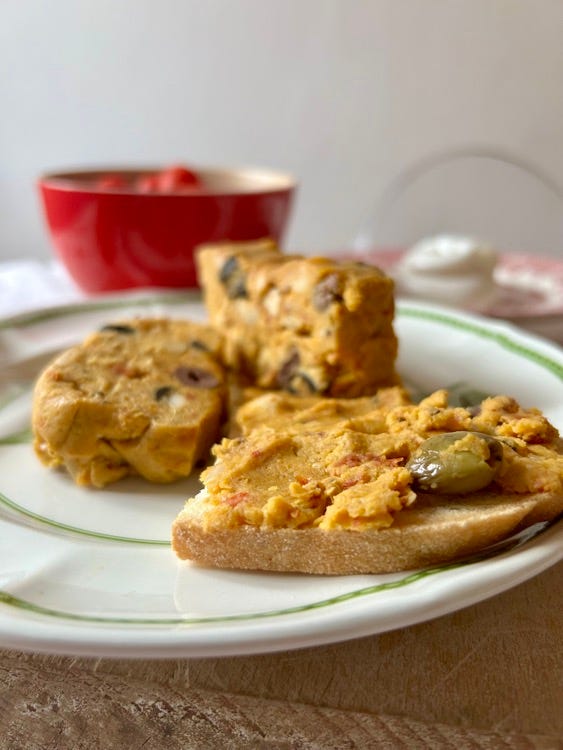
All because of fatty liver
Years have passed, but my aversion to liver has not. Who knows how I would have fared in ancient Rome, where rich people loved a dish of Greek origin, namely liver with figs (iecur ficatum).
This recipe is the origin of both pâté and pasticci.
Both derive from pasticium (a mixture of water and flour) already mentioned in De re coquinaria, a recipe book dating back to the 1st century AD, commonly attributed to the gastronome Marcus Gavius Apicius but written by an anonymous compiler towards the end of the 4th century AD.
You may ask, what does pasticium have to do with iecur ficatum? Simple, the former wrapped the latter. The filling, fattened liver from pigs, sheep, or even farmed moray eels, could also be mixed with meats, fish, fruit, and vegetables.
The word pasticium remained in use in Italy in vernacular Latin of the late Middle Ages. In Old French, it became pâte, then pâté (which means the same as the Italian pasticcio). Consider that patisserie (confectionery), before referring to buttery pastries filled with cream, referred to savory preparations with an outer shell enclosing a filling of slow-cooked meat.
Over time, puff pastry, shortcrust pastry, or brisée began to be used for the outer crust. But the animal’s skin and carcass were also used. This is the case, for example, with the humble figadê, a dish from Romagna’s cucina povera. It consists of pork liver slices wrapped in netting and cooked for a long time. It’s not a pâté, but the family resemblance is unmistakable once you know the story. To understand the connections, I suggest reading Artusi’s Pane di fegato (Liver Bread) and Pasticcio di Fegato (Liver Pâté): recipes N. 374 and N. 375.
The Italian pasticcio
The term pasticium changed to pastello and then pasticcio. The Anonimo Fiorentino, a recipe book from the 1300s, already mentions them. During the Middle Ages, and especially during its most brilliant phase, the Renaissance, pastelli and pasticci were classified as servizi da credenza (cold dishes) or trasmessi (served between soups and roasts).
In today’s Italian cuisine, pasticcio is still an oven-baked dish, almost always a first course, prepared with a filling wrapped in a dough that is usually puff pastry or shortcrust pastry. The filling can be meat, vegetables, rice, or pasta; it is often a combination of pasta or rice with meat sauce and vegetables.
Timballi and sformati belong to this family. Yes, I know some timballi don’t have an outer crust, but as you know, cooking is full of ideas.
In Emilia-Romagna, at least two great pasticcio recipes survive: maccheroni alla ferrarese with its semi-sweet Renaissance shortcrust pastry, and bomba di riso.
The French pâté
Contemporary and traditional pâtés still have in common the fine grinding of the filling and the same cooking. However, this is now shorter than it used to be.
The most famous pâté, pâté de foie or pâté de foie-gras (also translatable as pasticcio of foie gras), originated in Alsace in the 18th century. At a certain point, it became so famous that it became synonymous with pâté tout court.
From the 18th century onwards, all meat pâtés, not just goose liver pâté, were flavored with fortified wines (such as sherry, Madeira, or muscat), wine distillates (such as cognac), cream, eggs, and spices. If it has a shortcrust pastry casing, it is called pâté en croûte.
Past, present, and future of a recipe
Alexandre Dumas, Antoine Carême, and Auguste Escoffier claimed French ownership of pâté.
In Italy, no one claimed anything. Everyone made their own mess.
I have an opinion. It is correct to say that one recipe is French and the other Italian. By this, I do not mean to deny the historicity of the two recipes, nor to disregard the long journey they have made to survive.
To sum up. The evolution of a recipe does not annul the imprimatur of its origins, that is, the past. Of course, to grasp the traces of history, you need a trained eye, like a historian’s. The present, on the other hand, is a photograph that almost always summarizes the journey of each dish. Finally, the future of a recipe is the sum of all the presents that preceded it. Some will survive, but they will constantly change and adapt to new personal, family, local, and climatic interpretations.
The recipe.
Lentil terrine
The name comes from the earthenware container, now more often made of ceramic or glass, in which it is cooked. Terrine has a more rustic and less smooth texture than pâté.
This recipe is vegetarian. I used eggs as a binding agent, but for a vegan version, you could use boiled potatoes, and you would know how to substitute the cream and Parmesan cheese.
Serve it as a main course or as a one-dish meal, accompanied by a couple of sides and plenty of bread.
Since October was almost like summer, I used roasted tomatoes, which made the terrine more colorful, but again, adjust it to your liking with other lentils or maybe potatoes.
Speaking of lentils, I used yellow hulled lentils for their color and quick cooking time. However, green lentils are also fine. The pumpkin will take care of the color. Choose one with firm, not watery, flesh.
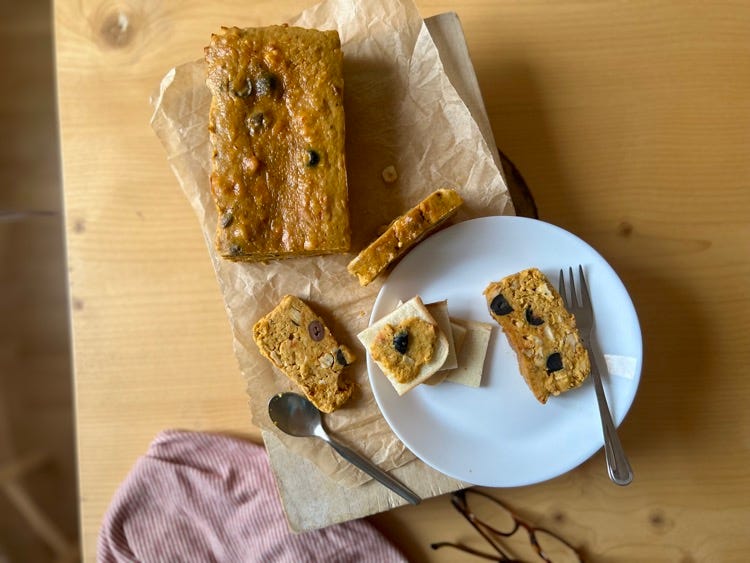
Lentil and other good things terrine
Serves 6
Rectangular mold 20x7cm
Ingredients
80 g shelled hazelnuts
50 g black olives
10 g Taggiasca or green olives
150 g hulled yellow lentils, weight of cooked lentils
170 g oven-baked pumpkin pulp
30 g roasted tomatoes, can be replaced with more pumpkin pulp
150 g eggs
30 g heavy cream
50 g grated Parmesan or other aged cheese
1 g dried oregano
3 g sea salt
Olive oil to taste
Method
Preheat the oven to 180 °C (350°F).
Toast the hazelnuts in a pan, chop them coarsely with a knife, and set aside.
Chop the olives coarsely with a knife and set aside.
Place all the other ingredients, except the oregano, in a bowl and blend to a cream with a hand blender.
Add the hazelnuts, olives, and oregano and mix.
Line a rectangular mold with parchment paper and pour in the mixture.
Bake for 40 minutes. If you insert a wooden toothpick into the center and it comes out clean, the terrine is ready.
Allow to cool completely before removing from the mold and cutting into slices.
Store in the refrigerator for a few days.
Proposal for 2026
I want to dedicate one newsletter per month to exploring a topic; sometimes it will be an ingredient, other times a gastronomic story. A bit like I did in the one you just finished reading.
You will recognize it by the title: Theme of the Month. What do you think, would you like that?
PS: Don’t worry, I won’t cancel Via Emilia, the spin-off of Food Notes from Bologna about things to do, see, and eat in Emilia-Romagna.
The next letter I write will be quite different from this one. More intimate and personal. The first chill in the air this morning made me realize I still need to finish switching my wardrobe for the season.
It’s time to welcome the new season. Not only in my wardrobe, but in my life, too. I have things to tell you, dear reader, but give me a little time to put my thoughts and words in order. A presto.
Your cook and writer, Monica
If you like, share your thoughts, experiences, and ideas in the comments, click on the heart if you liked the newsletter, and share it with anyone who might appreciate it. Mouth of word is my fuel. Grazie.
You can also find me on my blog: Tortellini&CO and on Instagram.
I'm not a pate-pasticcio eater, but I loved to know more about the recipies - and would be great to learn about other dishes. If you write your Theme of the Month, I'd be an aviduous reader! Please write about foccacia, there are so many types... And I've never read a nice piece about its history.
I grew up eating a lot of Triestine food as my mother grew up in Trieste. In our house, pasticcio was the name for lasagna. I found this forum that explains how the non-triestini get confused when Triestini speak of pasticcio but mean lasagna. https://www.atrieste.eu/Forum3/viewtopic.php?t=5508